Thursday, April 27, 2017
2017 Pantone Colors and C-Lon Bead Cord Colors
Friday, May 8, 2015
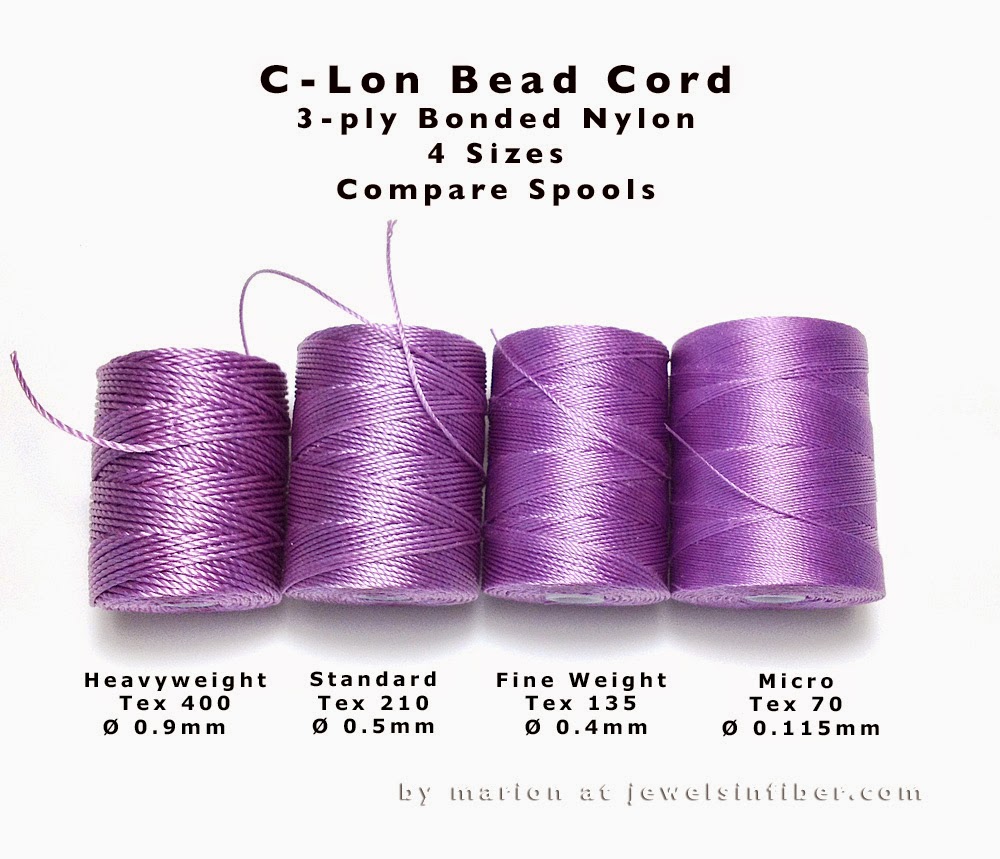
C-Lon Bead Cord - Comparing Sizes
![]() |
| C-Lon Bead Cord - 4 Sizes in Orchid |
Wednesday, October 24, 2012
Crown Knot Bracelet Class at BABE
The crown knot is a bit bulkier than pearls knotting and is easier to keep snug against the beads. It especially well suited for stringing beads with uneven holes, or when beads need to be kept apart as multiple crown knots can be made between beads. Multiple crown knot form a sennit with a similar appearance as the 8 strand braid in kumihimo, but it is made with only half as many cords for a braid/cord of similar diameter.
This knot is used extensively in Tibetan, Chinese and Japanese knotting. The four fold aspect of this knot is in perfect harmony with Buddhist principles. It is completely completely symmetrical. It is often used in malas. In addition, tying crown knots can become a form of prayer, a meditation.
In the afternoon we will make the bracelet ending, integrating the loop in a seamless fashion with no cord ends remaining. This type of ending can be applied to other techniques such as micro macrame and kumihimo.
![]() |
| Joining Hands after a Crown Knotting Class |
The class manual has a lot of info that goes beyond the class project and can be a guide for further projects you may want to do after the class.
Come and join us at BABE, a few spaces are still remaining and online class registration ends this Saturday, October 27!
Sign up for Classes at http://www.beadextravaganza.com/register.htm
This is my 4th time teaching this class at BABE. I will have two teachers assistants this year, so we will have a fabulous class with lots of individual attention. The BABE show takes place on Saturday and Sunday. I will be there with supplies and kits. There will be demos - I will do 2 demos, one on Saturday on the new Bead Cluster Kumihimo Kit and one on Sunday on the Shambhala Bracelet, an adaptation on a classic Chinese design - see earlier blog. BABE has great classes and a great show with lots of fabulous vendors!
Update November, 2016
This class is now available as a kit. I spent time creating a new manual that cover everything that was taught in the class plus more with lots of pictures, and illustrations. The manual has over 40 pictures and diagrams. –> Crown Knotting & Fiber Endings Bracelet Kit
Thursday, June 23, 2011
Circa 1975...

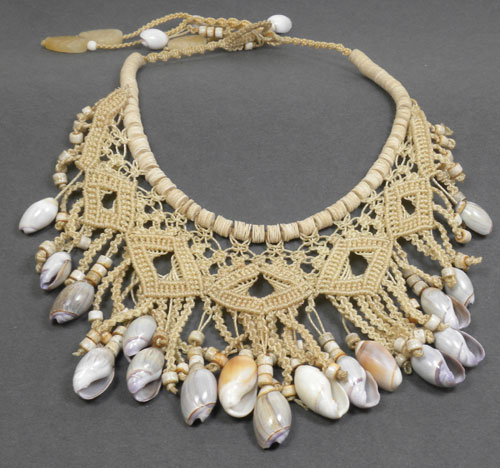
A visit from the past... I must have knotted this piece around 1975 with either Conso Natural or Macraworld Natural Nylon #18. I was still making traditional macrame jewelry.
It came back for minor repairs, plus an extension. Some of the paper thin shell heishis got broken overtime and needed replacing. C-Lon Bead Cord Wheat worked well for the repair as it is the closest color to the Natural circa 1975. I added a few light colored gemstone leaves at the end of the extender as I do not have anymore of these shells in stock.
The collectors were concerned with the neckpiece became a bit stiff over time. I gave the piece a nice wash. I use shampoo and a toothbrush to clean the surface, rinse with lukewarm running water and blot dry with a towel. Let dry overnight. The nylon became nice and soft again. Now I better ship it back. They have been patiently waiting!
Saturday, April 9, 2011
Tips: How to Cut C-Lon Bead Cord and Get Rid of the Curls

This picture shows all four sizes of C-Lon Bead Cord and the sizes of Miyuki beads that can be strung onto the cord using a beeswax self needle. See one of my earlier blog about the best way of loading beads onto cord. From left to right:
- C-Lon Tex 400 Bead Cord with Miyuki E's (twice/2x), 6/0s, and 8/0s
- C-Lon Bead Cord with Miyuki 6/0s (2x), 8/0s, and 11/0s
- C-Lon Fine Weight Cord with Miyuki 8/0s (2x), 11/0s, and 15/0s
- C-Lon Micro Cord with Miyuki 8/0s (2x), 11/0s, and 15/0s
C-Lon Bead Cord and to a certain extend C-Lon Tex 400 Bead Cord, the 'heavyweight bead cord', tend to curl. This can be especially annoying when working with micro macrame, as it makes the process of finding the right cord to work with more daunting especially when working with a multitude of cords. For applications such a crochet, knitting or kumihimo with EZ-Bobs, the cord having a memory of being on the spool all curled up does not matter. For anyone wanting the curls to go away, several solutions come to mind.
No More Curls Methods
- When unwinding the thread, give it a pull one arm's length at a time.
- Cut the cord the day before and add a weight to the ends overnight.
- Steam the cord.
- Iron the cord with a warm iron - a hot iron will damage the cord.
Alternative Method
Here is a another good method for micro macrame and Cavandoli knotting, when you need multiple cords, all of the same length. I use this method for workshops or when I plan my work a day ahead of time.
- Set up 2 winding posts, warping posts or cup hooks set into pieces of wood attached by a C-clamp to fixed positions at the distance desired for your cord ends.
- Attach the cord to the post/hook on your left (post/hook #1).
- Unwind the cord towards the second post/hook and give it a hard pull.
- Wind it around the second post/hook on your right (post/hook #2).
- Return to post/hook #1, unwinding, giving a hard pull and wind the cord around #1.
- Repeat steps 3-5 however many times until you have the desired number of cords.
- Tie the end back at post/hook #1.
- Optional - Let the cord sit on the posts/hooks overnight.
- Cut the cords at post/hook #1. Hold the cords by their fold at post/hook #2.
Best with your creative projects! - Marion
To purchase C-Lon Bead Cord > Marion Jewels in Fiber Store
Note on Ironing C-Lon Bead Cord
Use a warm setting. The lowest setting on my iron is acetate/nylon. I tested it with 6 - 48 inches long cords folded in half (24 inches long from fold/loop to ends). For speed I raise the setting to polyester, but then you need to iron quickly. Do not leave the iron in one spot with higher heat setting. Nylon will melt!
Blocking? More on the Knitted Bracelet...
Blocking knitting is a simple technique used mostly by professional knitters and knitting aficionados. The piece of knitting is pulled and stretched into the right shape, laid flat, and pinned in place. Then several methods can be used to actually block the knitted fabric: wet blocking, steam blocking, or spray blocking.
Regardless of the method chosen, the fabric can be shaped first, then pinned, then moistened, steamed or sprayed last. The sequence can be changed by wetting, steaming or spraying first, then shaping and pinning, then letting it dry. This process, if well done, makes the knitted pieces more even, making it easier to seam them together into garments. It evens the stitches out making them look more regular. It helps the knitted pieces hold on to their shapes.
Still intrigued by the idea of blocking the bracelet made with bonded nylon, I decided to experiment... by blocking with rubbing alcohol (see my blog about bond). So after first checking that alcohol did not affect the fresh water pearls, I was ready to test this process and isopropyl alcohol turned out to be the perfect blocking agent for bonded nylon.
To block your knitted bracelet, you will need the following tools:
- A Macrame Board (a project board with measuring lines or a Lacis Board and a ruler)
- 1 1/4 " Steel T-Pins
- Isopropyl Rubbing Alcohol
- Cotton Swabs (Q-tips) or Small Rag (in color similar to the item you are blocking)
![]() | ![]() | ![]() |
![]() |
Process: Pin the bracelet right side up (with pearls up) to the board using the line or a ruler to shape the body of the bracelet into an even shaped rectangle. Pin the triangle leading to the donut button and the loop. Then after dipping the cotton swab into alcohol, dab the knitted nylon in between the pearls evenly. Let it dry. Remove the T-pins. The bracelet should now be nice and flat. If a bit stiff just shake it to loosen. It will loosen regardless as you wear it.
For more info on the knitted bracelet -> Knitted Bracelet with C-Lon Bead Cord & Pearls
To purchase a macrame board and T-pins -> www.store.jewelsinfiber.com/tools.html
To read more about blocking knitted items -> To Block or Not to Block...

Saturday, January 15, 2011
Knitted Bracelet with C-lon Bead Cord & Beads

While exhibiting at Stitches West as a vendor, I got many inquiries about knitting with C-Lon Bead Cord. Everyone wanted to see samples, so I proceeded to knit some, among them a bracelet with pearls. Then at the next show, equipped with samples, I got requests for the pattern for the knitted bracelet.
As I am getting ready for my third Stitches West 2011 in Santa Clara, in February, I will share my experience knitting with C-Lon Bead Cord and beads. I highly recommend using the Kollage Square Needles for knitting with C-Lon Bead Cord or any Bonded Nylon, it really helps prevent cramping of the hands. Bead & Tools Kits as well as the Kollage Square needles are available for purchase in my online store.
Since the first sample bracelet, I made a second one while in vacation in Mexico for my mother's birthday, then my aunt saw it and she wanted one... I have made many since then, all with fresh water pearls, natural or dyed, and gemstone chips. This pattern can be adapted to other types of beads.
Try it, have fun, and experiment! - Marion
Materials:
5-7mm Fresh Water Pearls
25 mm Donut
1 4-5 mm Small Rondelle
1 spool of C-Lon Bead Cord
Tools
2 Kollage Square Needles US Size 1 / 2.25 mm (DPN-7 inch long)
1 Kollage Square Crochet Hook US Size A / 2.00 mm
1 Tapestry Needle Size 22
1 EZ-Bob Small (Optional)
Scissors
Super Max Thread Burner (Optional)
Thread Conditioners & Adhesives
Beeswax
Fray Check or Poly Zap Super Glue (Optional)
Note: Once knitted in each bead will sits right in between two stitches. To really show the beads off, purl right before and right after inserting the bead. I also recommend working right off the spool rather than cutting the amount of thread needed before hand.
Step 1. Loading Beads
Wax the end of the thread right off the spool with the beeswax. Make a self needle by shredding the cord with the back of scissors. Re-wax several times. Cut the cord at an angle and twist the end. Load all the beads, re-waxing and/or remaking the self needle when necessary. For post on self needle made with beeswax, go to this post here and check the last option.
Step 2. Bracelet Body
Cast on 10 stitches loosely using the long-tail method and leave a 12 inch tail - it will be used for the button loop later on. Optional: wind the end on a small EZ-Bob.
Then knit the body of the bracelet with the following pattern:
Pattern:
Row 1: Purl
Row 2: * Knit 2, Purl 1, Slide Bead in, Purl 1, Repeat once* and Knit 2.
Row 3: Purl
Row 4: *Knit 1, Purl 1, Slide Bead in, Purl 1, Repeat twice* and Knit 1.
Repeat Row 1-4 ending with Row 2 until the body of the bracelet is the right length. See note on bracelet length below.
Step 3. Bracelet End
Decreasing stitches - continuing with a stockinette stitch:
Row 1: Purl the first 2 stitches together, purl the stitches in between, and purl the 2 last two stitches together.
Row 2: Knit
Repeat Row 1-2 until you have just 2 stitches left. Bind off the last 2 stitches leaving a 12 inch tail when cutting the cord.
Step 4. The Button
Pull the Donut/Button in place, by first pulling up right past the bead, then pulling the cord past the rondelle. With the tapestry needle stitch the cord in and out of the knitted end ending on the right side, right behind the donut/button. Knot off or bind the cord and weave in the end. Or another option is to burn the end of the cord using a thread burner and add a dab of Fray Check or Poly Zap for security. (The pdf version available with the bead kits includes a diagram.)
Step 5. The Buttonhole Loop
Use the cord tail (from Step 1) and crochet hook. Starting at the corner, attach the first stitch right into the knitting. Continue using a single chain stitch and work to the desired length (1" 1/4 for a 25 mm donut). Insert the crochet hook into the knitting right at the corner and draw the cord through. With a tapestry needle reinforce the binding. Knot or bind the cord and weave in the end, or burn the end and add a dab of Fray Check or Poly Zap for security.
Notes:
Casting on: Cast on loosely. As bonded nylon has no stretch, if you cast on too tightly, it will be difficult to knit the first row. The first row in this project is purled as it is a bit easier to catch the cast-on stitches when purling.
Bracelet Length: If the donut/button measures 1 inch in diameter, your wrist is 7.5 inches in diameter, you will need to make the body of the bracelet about 6.5 inches long. Even though the bracelet is knitted with bonded nylon and bonded nylon has no stretch, knitting tends to stretch a bit once it is worn so make allowances when measuring.
Alternative to Attach Donut/Button: Use a coated beading wire such as Softflex and crimp.
Want to Block the Bracelet? Go HERE for this info.
Shop for Bracelets Kits, Kollage Square Needles and get a printed pdf of this pattern: http://www.store.jewelsinfiber.com/knit.html
This information is for your personal use and enjoyment only. You are of course welcome to refer to this website. Thank you for your understanding! - Marion
Please do not copy or reproduce this information for commercial purposes without prior authorization. All rights reserved © 2010-17 by Marion Hunziker- Larsen.
Monday, October 11, 2010
Nylon for Jewelry... Bonded or Waxed?

Nylon #18, a cord made originally for upholstery, used to be available waxed or bonded in the USA, but sometimes in the late 70's the waxed variety was mostly discontinued. Bonded nylon is better when used in industrial sewing machine.
Nylon was originally invented in 1935 by Wallace Hume Carothers at DuPont as an alternative to silk for stockings. Nylon is a continuous fiber similar to filament silk. Continuous filament fibers makes nylon thread and cord very strong. Polyester on the other hand is a spun fiber mimicking cotton with shorter fibers spun into thread. Spun thread or cord is usually less strong, has more stetch and breaks more easily when pulled. This makes cotton or polyester good choice for sewing as the thread are less slippery. For jewelry making, silk and nylon are better choices when no stretch is desired.
Waxed cord is a bit easier to knot but harder to un-knot than bonded cord. There is a learning curve, for example for tying double half hitches in Cavandoli knotting with bonded cord versus wax cord, but once it is mastered bonded cord is a better choice.
Advantages of bonded versus waxed nylon
- Better abrasion resistance
- Easier to undo knots
- Bond outlast wax
- Wax is allergenic
A consistent bond quality is essential to a cord brand. Drastic changes in bond levels can be a real problem. This is what happened with Conso Nylon #18. The newer supply had a drastically lower bond level than the older supply and the newer dye lots did not match previous ones. Everyone was returning the new supply and Conso discontinued manufacturing bonded nylon.
Bond whitening
When the bond or tack experiences friction or abrasion, it will go from its transparent form to more of a white/grey color....think of cooled wax. When you break a colored candle, at the crack or breaking point you see white in the color. This whitening is going to happen with all colors but shows up more in the dark colors and is almost impossible to completely avoid. It can be worse when the bond level is on the heavy side and it is more noticeable on darker colors.
I have been making jewelry with bonded nylon and silk all my professional life. My very first pieces were made with waxed cord. Some of my pieces in my personal collection were made many years ago and have been worn extensively. Other than a slight fading and an occasional washing, they are in remarkable shapes.
In 2005 after a disruption of bonded nylon supply, I started an online supply store specializing in bonded nylon and silk thread & cord for my students. - Marion
Sunday, February 7, 2010
C-Lon versus S-Lon
I get many questions about Superlon or S-Lon and the difference between this product and C-Lon.C-Lon first produced the C-Lon Bead Thread in Size D in December 2002. In March 2005 the Super-Lon Beading Thread, a 'new product', was announced by another company.
C-Lon started producing C-Lon Bead Cord in 24 colors, then 32, now 88 and soon 104. Superlon or S-Lon is now producing S-Lon Bead Cord in 65 colors. Some of the color names are different, but the actual colors and quality of the thread seem to match C-Lon exactly. The spools sizes and yardage are different. C-Lon Bead Cord used to have 86 yards per spool, new production has 92 yards. S-Lon Bead Cord 77 yards.
In 2007 C-Lon added the C-Lon Micro Cord, now available in 32 colors. S-Lon in late 2009 announced a new cord called Superlon or S-Lon Micro Cord available in 8 colors. The spool size is different and yardage 10% lower than C-Lon, 287 yards versus 320 yards.
When the S-Lon Bead Cord was announced, I remember questioning the name and wondering if it would the same product as C-Lon, but some of the color names were different so I hoped it would be new colors... When I received my order I was so disappointed as it was the same exact cord in the same exact colors a C-Lon, most likely made in the same exact factory, so a knock-off product... Of course all perfectly legal... just as Starbucks moving next to local espresso bars, large box stores putting smaller stores out of business, and then raising their prices... all part of the great game of competition... but we can choose whom we support.
When I opened the online store in 2006, many of my students could not find bonded nylon in their local bead stores. Only coated wire for stringing beads was easily available. I started the store with C-Lon and then expanded to all the nylons I use in my own work. I do not carry S-Lon nor plan on using it. Should you?
Photo: The spools on the left are the C-Lon Bead Cord. The shorter, plumper spools on the right are the S-Lon Bead Cord. Shorter yardage on S-Lon by 10-12%.
May 18, 2015 Update
C-Lon developed the Tex 400 size starting in 2008 with 24 colors. They have since added new colors in 2010, 2012, 2013, 2014 & 2015. The last 8 new colors of C-Lon Tex 400 arrived in February this year, bringing the collection up to 108 colors.
In May 2015, I received a notice that S-lon has added new colors of Tex 400 bringing their collection to 100 colors. I am not even going to check on their colors as most likely they are the same with some name changes to keep everyone confused.
May 12, 2020 Update
C-Lon has added more colors in the Fine Weight and Micro sizes, plus they have introduced smaller spools in these two sizes making it more affordable to buy more colors. S-Lon has paired down their color offerings and are stocking less colors than in the past.
Here is what's available at this time - Updated May 2020
116 Colors of C-Lon Tex 400 Bead Cord - Heavyweight Tex 400 ~ Ø 0.9 mm - 39 yd/36 m
S-Lon - 64 colors - 35 yards per spool
116 Colors of C-Lon Bead Cord - Standard #18 Size Tex 210 ~ Ø 0.5 mm - 92 yd/84 m
S-Lon - 94 colors - 77 yards per spool
60 Colors of C-Lon Fine Weight Bead Cord - Tex 135 ~ Ø 0.4 mm
Original Spools 136 yd/124 m - New Spools 50 yd/46 m
S-Lon - 20 colors - 118 yards per spool
48 Colors of C-Lon Micro Bead Cord - Tex 70 ~ Ø 0.115 mm
Original Spools 320 yd/293 m - New Spools 100 yd/91 m
S-Lon - 18 colors - 287 yards per spool
36 Colors of C-Lon Bead Thread - Size D - Tex 45 ~ Ø 0.11 mm - 80 yd/73 m
S-Lon - 36 colors - 75 yards per spool
38 Colors of C-Lon Bead Thread - Size AA - Tex 35 ~ Ø 0.09 mm - 75 yd/69 m
S-Lon - 24 colors - 75 yards per spool
August 2022 Update, check this new post for an update comparing the colors across the 2 brands. This new update includes charts showing how the colors intersect.
Not sure which size you already have or need? Request a sample card at no charge.
Not sure which colors you already have? Send numbered snippets in an envelopewith your name and email address to Marion Jewels in Fiber, PO Box 6776, Chico CA 95928. Keep an exact copy of what you send for later reference. As soon as we get it, we will identify the snippets for you and reply by email. Also check this post on how to identify C-Lon colors.
Thursday, June 12, 2008
Colors
When do we have enough colors? As an artist, designer and artisan working primarily with Nylon #18/C-Lon Bead Cord type thread, I struggled for many years with a limited color range, unreliable supplies, a lack of quality control, companies going out of business... All of this was of course before to C-Lon got into the thread business.C-Lon has now 64 colors, Mastex 22 colors, Conso 14, Beadsmith 17 (Beadsmith may no longer produce their Nylon #18, every time I reorder a few more colors have been discontinued). In addition I also use vintage cords, colors produced in the past by companies no longer in business, discontinued colors and old dye lots. Vintage cord is difficult to come by to newcomers in this field. So essentially most of us have about 100 colors to work with if we are willing to mix brands. Is that enough?
While pondering on this question, I decided to take a look at artist colored pencils. I easily found 9 artist quality brand with sets ranging from 12 to 132 colors. All the sets come in numbers such as 12, 24, 36, 49, 72, 96, 120 and 132 (Prismacolor only). In all the sets the colors are arranged chromatically using different logical systems. Keep in mind that color pencils can be layered, thread can only be juxtaposed. Then I looked at the Madeira Rayon thread used for machine embroidery and they boast 356 colors...
... Back to the nylons: Conso has not changed or added colors for 25 years. Mastex has reduced its color range. Oh, I forgot a sub-brand, S-Lon, well it's just a fact simile or exact duplicate of C-Lon in 51 colors. So we can forget about that brand as an option for additional colors. C-Lon is the only company that may be willing to expand their offering. So the main question remains:
Are 64 colors enough? Or do you still dream of more colors...
Grateful to have 64 colors! ~ Marion
Post your feedback on this question...
Added on January 9, 2009: 2008 saw the shrinking of company offering Nylon #18 with Mastex going out of business :(. I am always sorry to see our choices shrinking. On a positive notes C-Lon decided to expand their colors. I was asked to advise as to possible new colors. As of a week ago 8 new colors are on order at the factory expected to be released toward the end of February. So 64 is growing to 72. Hurrah!
New Heavyweight C-Lon Tex 400 Bead Cord

Did you get the new heavyweight C-Lon Tex 400 Bead Cord? What's you opinion on this new thread?
Post your comments on this thread, send pictures of pieces you have done with it...
It is available in 16 colors for now.
Update - This cord is now available in 24 colors and I have since had the chance to use it for a square knot bracelet I taught for an enrichment class to 4th-8th graders. The resulting bracelets made or attenpted were great for some and not so great for others, but bear in mind that for most of the students in this class, it was their first introduction to square knotting!
I will do a new blog entry as soon as I get the chance.