Showing posts sorted by relevance for query griffin. Sort by date Show all posts

Saturday, March 12, 2016

Griffin Jewelry Silk - Spools versus Cards


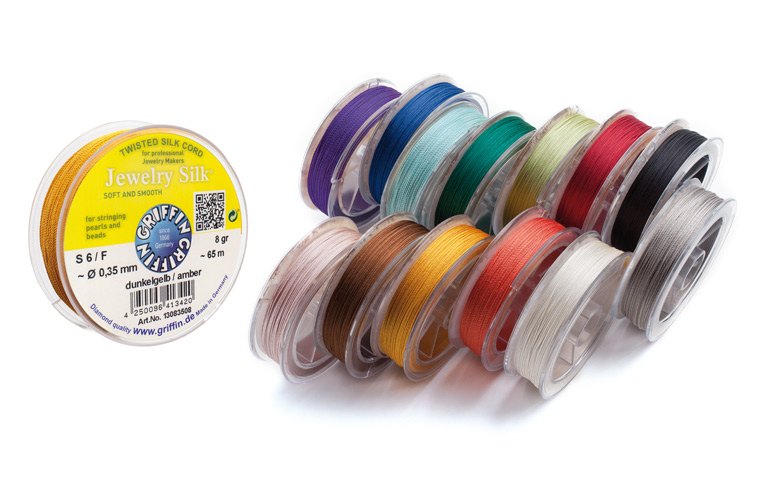
Griffin Jewelry Silk on Spools


Griffin Jewelry Silk on Spools

The Griffin Jewelry Silk is a high quality filament silk from Germany. This silk is a standard beading silk that has be made for many years. Griffin has been around since 1866. The thread quality, diameter and colors are incredibly consistent. It shows the high quality standard levels at the factory where this thread is made. The silk on the spool is a 3-ply cord with a left twist made from 100% natural silk.

I currently carry two sizes of the Griffin Jewelry Silk on spools > Marion Jewels in Fiber Online Store

6/F Ø - 0.35 mm - 65 meters per spool
8/FFF Ø - 0.42 mm - 40 meters per spool


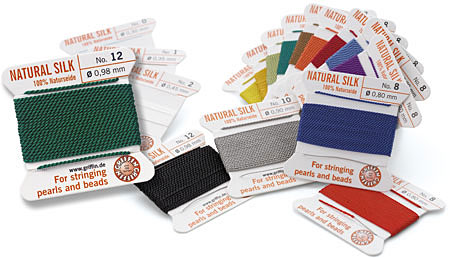
Griffin 100% Natural Silk on Cards


Griffin 100% Natural Silk on Cards

The silk on the card is the same silk as what's on the spools, but it is twisted into a cordon, a 2-ply twist with a needle attached at the folded end. One of the drawback is the short length of the card, only 2 meter long making it difficult to use this silk for longer necklaces, crocheted necklaces and any other project requiring longer length of silk.

So yes one of the solution if you need silk with a needle attached at the end like the one that comes on cards is to make your own. To make your own 2-ply silk cordon (re-twisted 2-ply cord) > Check this post on making 2-ply twisted cord with Griffin Jewelry Silk

Here is a chart that compares diameter sizes between the silk on spool and cards, plus 2 and 3-ply cordons made with the silk on spools. It is a handy reference for anyone working with this silk. Diameter sizes are approximate and based on information provided by Griffin.

Compare Diameter Sizes of Griffin Jewelry Silk and of Griffin 100% Natural Silk Cards

I hope this will help anyone with questions about how these two silk products compare. It will certainly make a handy reference when I am next asked questions about how to compare Griffin Jewelry Silk and Griffin Silk on Cards! - Marion


Monday, May 28, 2012

Griffin Jewelry Silk Bead Cord - Making Your Own 2-Ply Cords out of Spools


Silk is traditionally the best material to use for stringing valuable beads such as pearls, coral, amber and jade. It is soft, strong and drapes well. It does not damage softer beads. The Griffin Jewelry Silk Bead Cord is made in Germany from 100% high-grade filament silk tightly twisted into a 3 ply cord. It is available in 13 colors created to coordinate with gemstones as suggested by their color names. It is a good silk to string beads, for bead crochet or any other projects requiring a strong high quality silk. It comes on spools with enough yardage for many projects.
Griffin Silk Cards


Griffin 100% Natural Silk is usually available on cards as a 2-ply cordon with a needle attached to its end. The cards are only 79 inches (2 meters) long. It is often too short for longer necklaces and for application needing longer cords such as bead crochet. One of the way to get around this, is to make your own cordon.

Use the Griffin Jewelry Silk to make your own 2-ply cordon, add a collapsible needle and get what is available on a Griffin Silk Card but with the exact length you need for your project. A cordon is a two-ply made with a cord, twisting in the same direction of the cord. So since the Griffin Jewelry Silk 3-ply cord is twisted counterclockwise, make sure to twist in the same direction as shown in the illustration below. For references as to size comparison check this post > Griffin Silk - Spools vs Cards


I find the easier way to make a 2-ply cord is with at least two stationary hooks. Tie one end of the cord to the first hook. Wrap the cord around the second hook. The tie the end to the hook on your mini-twister or your cordless drill. Twist the cord counterclockwise until it starts kinking. Fold it onto itself. Tie it together and let is twist clockwise by itself. If you need a needle, attach the needle before laying the odd together and place it at the center hook, where the cord will fold onto itself.


Two-ply cord can be made out of many different types of cords, not just the Griffin Silk. The mini-twister or corder shown above is a good hand tool to use. Reversible drills with a hook attached are best for long cords.

If you are interested to make 3 and 4-ply cords, check the Learn Cord Making Tutorial and Tool Kit. The tutorial is available by itself for $10.00 and it has direction on how to make the tools needed for the project, or you can get the tool kit for an additional $15.00.

Let me know if you found this info useful, or if it needs clarifications. Best, - Marion

> Griffin Jewelry Silk by the Spool

> Tools for Cordmaking


Saturday, August 1, 2015

DIY Silk Tassels for Jewelry

Silk Tassels

One of the latest trend in jewelry is tassels. They are featured everywhere on malas, attached to bracelets, earrings and more... In fashion you can find them on clothing, belts, shoes, purses along with lots of fringes. Tassels can be made out of many different type of materials depending on their final use. They can be simple or complex. 

Here is a tutorial for a silk tassel well suited for jewelry. 

I found filament silk best suited for tassels. The weight and flexibility of the silk makes gorgeous tassels. Kanagawa 100 Denier Silk and Fujix Tire Silk come in an amazing array of colors. Kanagawa 1000 Denier Silk comes in 162 colors; Fujix Tire Silk in 121 colors; Griffin Jewelry Silk in 11 colors. The following tassel was made with Kanagawa color #5. The two Japanese brands, Kanagawa and Fujix Tire, are comparable and they are as far as I know the best filament silk available. Griffin Silk, a beading silk is also a very high quality silk suitable for tassels. 


Silk Tassels Tutorial

1. Cut a folded piece of cardboard a bit longer than the desired length of the tassel.


Silk Tassels Tutorial

2. Insert the thread in the cardboard fold and wind the thread around. 
This one was wound about 45 times around the card. 
The more you wind the thread around the cardboard, the fuller the tassel will be. 


Silk Tassels Tutorial

3. With separate thread, bind all the tassel thread on one of the end.
I go around the bundle twice, then tie the two ends into a flat knot.

4. Cut the thread along the other end of the cardboard while holding the bound end. 
Continue holding the bound end for next step. 


Silk Tassels Tutorial

5. Run the thread under lukewarm water to remove the folds and to make it easier to cut the ends. 
Blot the tassel with a towel to remove excess water. 

This step can be skipped with Griffin Silk, and with silk coming off of spools, but cutting wet silk is easier than cutting dry silk. It is just like getting your hair cut wet rather than dry...


Silk Tassel Tutorial

6. Continuing while the tassel is wet… 
With a separate piece of silk, wrap the tassel neck. 
Stitch the ends back toward the tassel ends. 


Silk Tassels Tutorial

7. To trim the tassel, wrap the tassel in a piece of plastic shed.
Use your sharpest scissors to trim the ends.


Silk Tassels Tutorial

Here is the finished tassel.


Silk Tassels Tutorial


The finished length of this tassel after trimming is 4.5 cm long.
The head is about 5 mm in diameter. 
The bottom of the tassel skirt is about 18 mm wide. 


Silk Tassels made with Kanagawa & Fujix Tire Silk

Tassels made with Kanagawa 1000 Denier Silk and Fujix Tire Silk.
Some are longer, fatter… The fattest one on the right was made with the full card. 


Silk Tassels

Tassels made with filament silk.
The two on the right are made with Griffin Jewelry Silk Size 6. 

The Kangawa and Fujix Tire silk tassels have a bit more sheen than the Griffin ones. Griffin Jewelry Silk is another filament silk often used for stringing beads. It is less sheen and more grip, so a bit easier to handle than Kanagawa & Fujix Tire. It is available in 12 colors at this time. Griffin Jewelry Silk comes in spools. Size 6 has 65 meters per spool.  


Tassel made with Madeira Silk

Tassel made with Madeira Silk

This tassel is soft and fluffy, but the floss does not have the weight of the filament silk, so it does not hang quite as nicely. It might make a good tassel, but it would not be my choice for jewelry. Madeira Silk Floss come in 108 colors. It is made in Germany with spun silk from Switzerland.  


Tassel made with C-Lon Micro Cord

Tassel made with C-Lon Micro Cord. 

This tassel skirt is bit stiff. I may attach this ones to my keys or a purse, but I would not attach it to a strand of beads, nor wear it as a jewelry charm… 


I am now experimenting with tassels made with Chinese Knotting Cord, so far I really like the results with Micro Size E. > Read New Post on Tassels 

See latest post on tassel HERE

Silk - References


Silks available at Jewels in Fiber
All these fine silks are available at Jewels in Fiber online store

Here are the silks, I tested for tassels. I made the same types of tassels growing up in Geneva, Switzerland. I came up with a few improvements while making them this past week… Oh, I was told at the show I just attended that books are good to wind the thread around to make the tassels. I will try this next. 

I have several books on tassels, but I have yet to make one of the fancy tassel featured in them. If you are interested in further research in the art of passementerie, that is the French word for fancy decorative trimming such as tassels, braid and fringing, check books on tassels and look for future posts on the subject!



Sunday, January 6, 2019

Pantone Color of the Year 2019 compared to C-Lon Bead Cord and More

Pantone Color of the Year 2019 compared to C-Lon Bead Cord and More

Living Coral is definitively bright, lively, vibrant yet mellow at the same time. And yes it matches C-Lon Chinese Coral. 

To lighten it up, add a bit of Pink Lemonade to the mix. Darken it and make it unforgettable with Poinsettia. Add a bit of Sea Shell or Peach Glow for the bright edges and you capture the coral and clown fish perfectly.


Pantone Color of the Year 2019: Living Coral


Pantone 2019 Color of the Year


The background color is the exact Photoshop color swatch provided by Pantone. The color inside the square insert is their alternative color for printing. On the right are the cord and thread closest to Living Coral. 


C-Lon Bead Cord: Poinsettia, Chinese Coral, Pink Lemonade


C-Lon Bead Cord 

Chinese Coral is the C-Lon Bead Cord 2019 Color of the Year. It is available in the standard C-Lon Bead Cord with a 0.5 mm diameter. And it is available in the 0.9 mm C-Lon Tex 400 Bead Cord. Poinsettia on the left is a deeper rendition. Pink Lemonade on the right is a lighter variation. Sea Shell or Peach Glow can be used as highlights. 

C-Lon Bead Cord is a 3 ply twisted bonded nylon used for micro macrame, bead stringing, kumihimo, crochet and upholstery

Chinese Knotting Cord: 323-Chinese Coral, or 324-Guava, 322 Light Coral, 322.5 Pink Coral, 324.5 Light Guava


323-Chinese Coral

Chinese Knotting Cord is a braided nylon cord with a center core. It is used for square knot bracelets such as shambhala bracelet, plus much more. Size E and New E is a great size to make tassels
. 


323 Chinese Coral is available in the 0.4 mm New Size E,  0.6 mm Size H, 0.8 mm New Fine, and in 1.5 mm HDQ Size


322 Light Coral is available in the  0.6 mm Size Hand 0.8 mm New Fine. 


324-Guava, 322.5 Pink Coral are available in 0.4 mm Size E. 


324.5 Light Guava is available in 1.2-1.5 mm New Medium. 


Kanagawa-Fujix Tire Silk - KNK-91


Try these silk for tassels and for so much more... KNK-91 is the color shown above in the large photo. It is the closest match to Living Coral the Pantone color of the year. It has a beautiful sheen. This color can be found at the bottom right of this web page. KNK-93 and KNK-94 are good highlights and KNK-10 on the next page is a good darker deeper color. 


Griffin Jewelry Silk - Coral


Griffin Silk Coral Color
Griffin Jewelry Silk is a silk with a mat finish available in 2 sizes 6/F and 8/FFF. Coral is a good match for Living Coral. 

I hope this will help you choosing new colors for 2019! - Marion


> Pantone Living Coral Color of the Year Animation

Wednesday, November 3, 2010

Tips: Best Ways of Loading Beads onto Cords

I get several emails a week asking me for the best way to load beads onto nylon bonded cord such as the C-Lon Cords or Nylon #18.

Here are some suggestions:
  • Big eye needles
  • Tapestry Needles or Beading Needles preferably with blunt ends such as bead Embroidery Needles - Size depending on the cord and beads sizes
  • Collapsible needles such as a Griffin needles
  • Threaders such as fine cord to pull your cord through. For example using C-Lon Micro Cord to pull through C-Lon Bead Cord. You can also use a needle attached to the threader or make a self needle with the threader.
  • Self needles using Fray Check by dipping or rubbing some Fray Check onto the end of the cord. Let dry overnight or at least for a few hours. Cut the cord at an angle and use it as a needle. Re-cut at needed.
  • Self needles with beeswax. Shred the cord with the blade of a scissor or a razor blade. Wax it. Shred it again and wax it until you get a nice point. Cut the end at an angle. Roll it with you fingers into a nice point.
The first 4 methods let you insert the beads with an actual needle, so they can be a bit faster than self needles. But since you also have to get the folded cord through the bead, it is sometimes too bulky for finer beads or thicker cords.

Loading beads with a self needle is best for beads with fine holes such as pearls, or when you wish to insert more than one cord into a bead.


Beeswax has several advantages over the Fray Check method. The beeswax does not require waiting for drying time. Fray Check tends to thicken the cord, whereas the beeswax self needle with a little practice gets the cord into a fine point that can get through finer beads than any of the other methods described above.

Note: Not all beeswaxes are equal. Some are sticky as they have too much residue left inside. My beekeeper tells me that the beeswax quality also depend on the bees diet. His thrive on a varied diet from the hills of the California coastal range from South San Francisco to the Santa Cruz Mountains, making his beeswax nice and hard. I leave mine close to a light so it soften a bit with heat, and applies more easily to the cord. Then it can harden right onto the cord making a sturdy self needle.

Of course in the end it is best to try all the different methods, find your personal preferences and your favorite way for specific projects!

Wednesday, August 5, 2009

New Book on Micro Macrame by Annika deGroot


One of the wonder the internet is the open flow of communication. I found out about this book through questions received by email from customers about the Tuff Bead Cord especially the Size 3. I ordered the book, and found to my surprise my online store listed in the resource page.

"Micro-Macramé 30 Beaded Designs for Jewelry Using Crystals and Cords' is a paperback book, written by Annika deGroot, published by St. Martin Griffin. The 144 pages are 10.8 by 8.5 inches. It is in full color throughout.

The book has 30 projects to choose from, a page on beads, a section of cords, tools and a creative way to make a padded knotting board. Many Europeans, for example, prefer working with hard pillows similar to the ones used for bobbin lace rather than traditional macrame boards. I use an easel as I prefer to work vertically to save myself from back and neck pain. Annika de Groot also has a section on setting a cabochon by gluing it to a piece of ultrasuede and stitching beads around it. The photos used in the knot section are clear, most of the basic knots are shown with some naming variation such as calling the standard square knot a flat knot. A flat knot as far as I know is a square knot without its central cords or inner cords. Terminology is not very consistent in the world of knots, as different traditions mingle. In addition it has a tip section, a resource page and an index. Several of the resources listed are wholesale only.


The 30 beaded designs include good projects for beginners at micro macrame in the macrame lace tradition, with lots of loose thread between the knots filled with seed beads and crystal bead such as Swarovski. The list of materials for each project names the actual colors and brand names of the cord. Many ask for Tuff Bead Cord in size 3 and 5. Two ask for C-Lon Bead Cord, 4 Conso and 2 Stringth, a sub-name of the Tuff Bead Cord packaged by Rio Grande. Colors and brand name of course can be easily changed as all Nylon #18 and C-lon Bead Cord can be used for any of the projects other than those requiring Tuff Bead Cord Size 3, a different thread diameter.


Many of the designs in Annika's book have a vintage feel reminiscent of the Victorian era, similar in style to Marie Le Sueur's book. Both books are focused on macrame lace, Marie Le Sueur's is in French, a big disadvantage for anyone not well versed in 'la belle langue'. See April 2008 post on Marie's book. The advantage of macrame lace, with its many beads is the speed at which many of the designs can be done, but of course speed is a relative notion. For beginners, knots can be challenging, but of course one must start somewhere. Whereas for professionals like myself or 'power knotters' a term coined I believe by Kris Buchanan, knots seem just like keys on a piano to a concert pianist.


Most projects seem self-evident by just looking at the step by step pictures, at least for me, but please understand that I have not actually done any of the projects nor carefully read any of the instructions.

Visit Annika's website and see if this is a style of micro macrame you want to explore. She has a free download of one of the design in the book, a great feature before buying the book. Then if so inclined, you can buy it right on her site.

Annika's website: http://www.annikadegroot.com

Sunday, June 11, 2017

Loading Beads onto Cord & Thread - Needle Types & Sizes, Thread Leader and Self Needles

I wrote a post quite a while ago on the best way to load beads onto cords. It is one of the most common questions I get. It is a lot easier to refer to a post than to answer everyone individually. It was also time to update the info with lots of visual aids. This info is crucial to so many techniques from Peyote Stitch, Bead Kumihimo, Micro Macrame, and just Stringing Beads or Making Malas.


Needles


Needles for Beaded Jewelry

From left to right:

Big Eye Needles - Super easy to use as the needle opens fully from tip to tip. The needle consists of two long needles soldered together at each end, so when you separate them, in the middle the needle eye is giant. On the negative side, the needle is fairly thick so it cannot go though many beads as their holes are too thin, plus it can snag fragile material such as monocords (C-Lon Bead Thread, Size D and AA, KO and Miyuki Beading Thread) or fragile ribbon such as the knitted Panaché ribbon. Occasionally the solder joint breaks, so have an extra on hand just in case.

Wire Needles with Collapsible Eyes - Such as the Griffin Needles. They come in three sizes, thin, medium, and heavy. They are a good choice for stringing lots of beads, and since the eye collapses, the needle does not take a lot of room, so it is possible to get a double cord or thread into a small bead hole. But as the eye collapses, most of the time the needles are not reusable. On the plus side, the packages have 25 needles. 

Tapestry Needles - They come in many sizes from Size 20 (the thickest) to Size 28 (the thinnest) and they all have blunt ends. Chenille Needles are similar to Tapestry Needles but have sharp ends. 

I try to use blunt ends always for loading beads onto cord and thread. I am less likely to poke myself and to get my project ruined by staining it with blood. Also if you are making multiple passes, blunt ends are best for lowering the likelihood of going through the thread of the previous passes. 

Bead Embroidery Needles
Bead Embroidery Needles - These beading needles in size 10 and 12 are similar to Beading Needles, but they are shorter, plus they have blunt ends. These are pluses all around for leather wrap bracelet, Peyote Stitch, and very fine thread. 

Guide for Needle Sizes


This is a general guide as to the best needle type and sizes for some common thread and cord used for beaded jewelry. It also give an indication as to the best needle size for finishing. 

I often use the next size down for finishing and a pair of pliers to pull the needle and cord through when finishing in micro macrame. I can squeeze a C-Lon Bead Cord in a Tapestry Size 24, thus making a smaller hole in my work, but the end of the cord that went through the needle will not be usable, it will have to be discarded. 


Pull Along Needle and Thread Leader Method


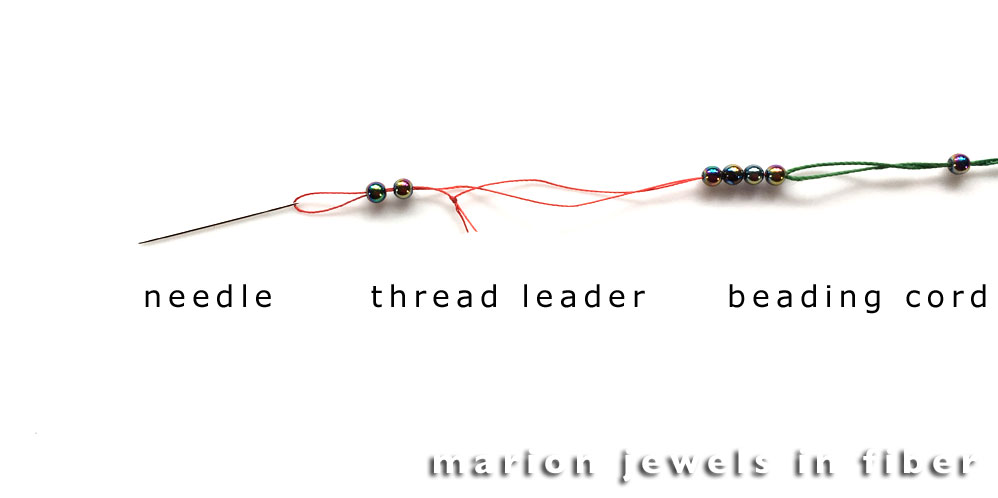
If the beads holes are too small to accommodate the cords and needles listed above, then a smaller pull along needle with a thread leader might be the best way. 

Pull Along Needle and Thread Leader


In this example, the 4mm hematite with an Aurora Borealis finish are loaded onto C-Lon Bead Cord. The bead holes barely accommodate the cord doubled over, so a big eye needle or a tapestry needle will not work. A collapsible wire needle might work, but it might damage the looped part of the cord. So this might be the best solution. The needle is a Tapestry Needle Size 26. The thread leader is a piece of C-Lon Micro Cord. A thinner needle and thread could be used such as a Bead Embroidery Needle and C-Lon Bead Thread Size D or KO/Miyuki Thread. 

If tying a knot does not work because the knot keeps the beads from sliding down, as I found out in my example, either choose a thinner thread or omit the knot as shown below. 

Pull Along Needle and Thread Leader


Self Needles


Fray Check for Self NeedlesBeeswax for Self Needles


 Self Needles can be made with Fray Check or Beeswax. 

The advantage for self needles is that there is no need to double the cord over to insert it into the bead holes. It can be done with a single cord or thread which is less bulky. Thus it allows a thicker cord into a bead hole.


Self Needle with Fray Check - Dip or rub some Fray Check onto the end of the cord. Let it dry. Cut the cord at an angle and use it as a needle. Re-cut at needed. 

Fray Check acts like a glue and coats the cord adding a bit of bulk to the cord. Making the self needle with beeswax (shown next) is the best way for loading beads onto cords when the size of the cord is close to the bead hole.  


Self Needle with Beeswax Method

This method is shown here with C-Lon Bead Cord Tex 400 as it is easier to photograph than thinner cords, but I use this method for the standard C-Lon Bead Cord or Nylon #18 bonded nylon cord and thinner bonded nylons,  for silks such as the Kanagawa or Fujix Tire Silk, and other cord and thread. 

Self Needles with Beeswax Method

Step 1. With the scissor blade edge shred the cord end. 


Self Needles with Beeswax Method

This picture shows the shredded material. 

Self Needles with Beeswax Method

Make sure to shred each of the 3 plies evenly. 


Self Needles with Beeswax Method

Step 2. Run the wax multiple times over the ends. 


Self Needles with Beeswax Method

Step 3. Roll the ends counterclockwise and cut the ends at an angle with sharp scissors. Occasionally as you load beads, you might need to re-wax and recut the end. 


The Beeswax Self Needle has many advantages:


• No need to double the cord over unless you want to use two cords, then join them together with the beeswax. The beeswax will hold cords together. 

• No drying time

Note: Not all beeswaxes are equal. If yours is a bit too soft or sticky place it in the refrigerator. It will help making it harder. If yours is too hard, keep it by a warm light.

I like my beeswax on the hard side... and I also often use pliers with this method to pull the cord through a tight hole. But of course sometimes a bead hole is just too narrow. Then the beads can be set aside for another project done with a thinner cord or it can be reamed.  A post about reaming beads will be on my list of next posts, so stay tuned. Follow my blog or sign up for newsletters to hear the latest news or visit my news page.  It has links to all my technical posts at the very bottom. 

In the end it is best to try all the different methods, and find your favorite way for your projects!

Links and References


-> Needles


Sunday, January 24, 2021

Making Malas - How to Choose Cord Colors

A while ago I wrote a post with step by step instructions on how to make Malas. This was after getting a lot of requests on the best cords to use to make Malas and how to make the tassels. Go to the post HERE. Friday, I got a phone call asking me about color choices for a Mala with Rose Quartz, and it requires some follow up and a few tests... so I may as well share this with everyone.

These tests are a great way to choose colors. In addition, they will confirm that the cord size chosen for stringing the beads and knotting between the beads is the correct size. 

The size of the knots in between the beads need to be just right. The knots need to be large enough to keep the beads separated, but if they are too small, they may partially disappear into the bead holes. If they are too large, they take over visually.  

As a rule of thumb, use the standard C-Lon Bead Cord doubled over for 8mm and 10mm gemstone beads, and use C-Lon Fine Weight Bead Cord (that's the Tex 135 with a 0.4mm diameter) doubled over for 6mm gemstone beads. If you use wood or metal beads it gets more complicated as there is not really a standard hole size for these beads, so testing becomes even more crucial. 

Here are my tests:


Making Malas - How to Choose Colors and Cord Sizes


The cord for stringing the beads and knotting in between is the standard size of C-Lon Bead Cord (the Tex 210 with a 0.5mm diameter). The colors are from top to bottom: FL French Lilac, PTL Petal, and AP Apricot. 

The rose quartz 10mm gemstone beads I happen to have are a bit milky so they do not show the bead holes. Other rose quartz beads I have had in the past have been more transparent. French Lilac may have shown as a dark line at the center of the bead, and Apricot may have added a yellow glow to the rose quartz I may not have wanted. 


Making Malas - How to Choose Colors and Cord Sizes


As for the choices for the tassel color, I chose to go with Chinese Knotting Cord Size E, or New E, as the tassel will be large and require about 50 yd of cord. For these tests, from top to bottom, I chose Chinese Knotting Cord Size E: E-415 French Lilac, NewE-312 Pink Blossom, E-320 Bubblegum, and E-941 Pale Coral. 

Other good choices for tassels include the next size up of Chinese Knotting Cord (Size F), silks such as Kanagawa or Fujix Tire, or Griffin Jewelry Silk on spools. 

Links & References: 

–> DIY Instruction on Making Malas with a Tassel

–> C-Lon Bead Cord

–> Chinese Knotting Cord Size E or New E

–> Matching C-Lon with Chinese Knotting Cord and Silks