Friday, July 15, 2016

Matching C-Lon Bead Cord Colors with Kanagawa & Fujix Tire Silks, and Chinese Knotting Cord Size E

Matching C-Lon Bead Cord Colors for Malas

Matching colors across different brands is a difficult task in person. Doing it online is a daunting task. It requires opening several windows at the same time and a large screen.

Anyone making Malas or looking to match colors across these brands will find this post useful. Photos showing matches and relations between colors will be added to this post as time permits.


Please keep in mind that colors do shift with dye lots, and colors on your monitor or printer may not perfectly match the actual color of the thread and cord. 


The cord and thread is shown in shade groups. Rows are marked based on the C-Lon Bead Cord Color Chart. A PDF table is available in Resources at the end of this article. The table is organized alphabetically by C-Lon Bead Cord color codes. The C-Lon Bead Cord and C-Lon Tex 400 are both shown in the picture below with the Tex 400 at the top. Occasionally there is a slight shift between the two due to dye lot variations, otherwise the colors are the same. 


C-Lon Colors - Row 1 Aurum & Myrtle Green

Compare C-Lon Bead Cord Colors with Silks and Chinese Knotting Cord

AU Aurum - KNK-158
MYR Myrtle Green - KNK-138

The other New Colors are spread around below. 


C-Lon Colors - Row 2
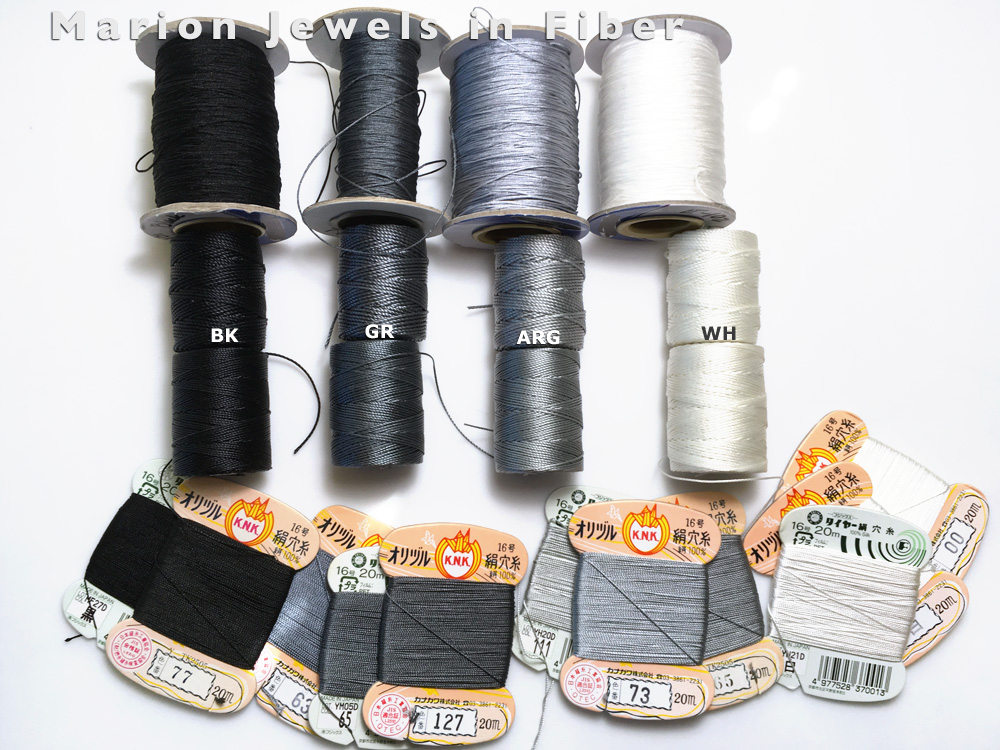

Compare C-Lon Bead Cord Colors with Silks and Chinese Knotting Cord


BK-Black - KNK-BK or FJX-402, KNK-77 a bit richer, warmer + CHKC-E-101 Black
GR Grey - KNK-65 tad lighter, FJX-63, KNK-127, KNK-66 to catch more blue + CHKC-E-219 Dark Grey
ARG Argentum
- KNK-73, KNK-65, FJX-111 lighter + CHKC-E-205 Silver
WH White - KNK-WH, FJX-401, KNK-00 currently the better match, or FJX-403 bit warmer + CHKC-E-102 White

Currently the Tex 400 ARG dye lot is a bit lighter than the standard C-Lon and FJX-111 is a better match catching the highlights in the nylon perfectly.


Compare C-Lon Bead Cord Colors with Silks and Chinese Knotting Cord


SLV Silver - FJX-12 + CHKC-E-218 Concrete
NK Nickel - KNK-65, FJX-44 catches highlights, KNK-72
GM Gunmetal - FJX-21, FJX-114, KNK-128
CHA Charcoal - FJX-125 lighter but good tone, FJX-66 perfect catches deep tones, FX-77 catches deeper tones


C-Lon Colors - Row 3


Compare C-Lon Bead Colors with Silks and Chinese Knotting Cord


O Orchid - FJX-134 a bit lighter + CHKC-E-423 Lavender darker
PH Pale Heather - KNK-108 + CHKC-E-421 Light Orchid more saturated (not shown)
LV Lavender - FJX-05 cleaner hue, more saturated
FL French Lilac- KNK-107 + CHKC-E-415 French Lilac
MP Medium Purple - FJX-57 (not shown above)
PU Purple - KNK-24, FJX-57, FJX-130 tad redder
AM Amethyst - KNK-144 CHKC-E-427 Amethyst
VIO Violet - KNK-117


C-Lon Colors - Row 4


Compare C-Lon Bead Cord Colors with Silks and Chinese Knotting Cord


CRS Cerise - FJX-78, KNK-821 lighter
P Pink - KNK-172 best (not shown), KNK-170 bit duller, KNK-171 a bit darker, FJX-141 a bit brighter and more saturated
LO Light Orchid FJX-30 lighter and brighter, KNK-11 more saturated and darker
LTM Light Magenta- KNK-11 lighter and brighter + CHKC-E-325 Dynasty Magenta
RA Raspberry - KNK-6 CHKC-E-408 Fuchsia
GP Grape - KNK-22 CHKC-E-409 Grape
AZ Azalea - no close match found
PTL Petal - no close match found 


C-Lon Colors - Row 5


Compare C-Lon Bead Cord Colors with Silks and Chinese Knotting Cord


EGG Eggplant - KNK-801 (better with BC Black Current), KNK-801 more purple, FJX-157 (not shown) perfect shade, but washed down, lighter, not as deep CHKC-E-359 Dark Smoke
WN Wine - FJX-78 
RS Rose - FJX-37, KNK-170 more pink (close match to CHNK-E-316) CHKC-E-316 Geisha Gown more pink
BG Bubblegum - KNK-12 CHKC-E-314 Pink Lotus more pink
PL Pink Lemonade - KNK-93 CHKC-E-322.5 Pink Coral
CC Chinese Coral - KNK-91 CHKC-E-324 Guava


C-Lon Colors - Fluo Hot Pink - Neon Pink - Poinsettia


Compare C-Lon Bead Cord Colors with Silks and Chinese Knotting Cord


FHP Fluo Hot Pink - KNK-795 CHKC-E-315 China Pink lighter
PO Poinsettia - FJX-155 a bit darker, KNK-10a bit duller and redder 
NEP Neon Pink  + CHKC-E-363 Neon Pink


C-Lon Colors - Reds + Orange


Compare C-Lon Bead Colors with Silks and Chinese Knotting Cord


VR Venetian Red - FJX-11 best, or FJX-79
R Red - KNK-1, KNK-2, or FJX-64 deeper tone CHKC-E-319 Plum a tad deeper
RH Red-Hot - FJX-10
SR Shanghai Red - KNK-4 CHKC-E-384 Poppy Red brighter, lighter
OG Orange - KNK-179 darker,browner, FJX-62 closest, KNK-5 more saturated


C-Lon Colors - Oranges


Compare C-Lon Bead Cord Colors with Silks and Chinese Knotting Cord


NEO Neon Orange - No exact match, KNK-5 redder and not a neon color
CHKC-E-929 Tangelo - Orange, brighter than all C-Lon
OG Orange - KNK-179 darker,browner, FJX-62 closest, KNK-5 more saturated
TN Tangerine - KNK-177
AP Apricot - FJX-61 a bit darker and more saturated
PSO Popsicle Orange - FJX-32 + CHKC-E-925 Mandarin lighter and brighter (shown below)
LC Light Copper - FJX-72 best (oops, not shown), KNK-99 a bit darker and more saturated


C-Lon Colors - Row 6 + Copper Rose

Compare C-Lon Bead Cord Colors with Silks and Chinese Knotting Cord


CPR Copper Rose - FJX-37  a tad brighter, or KNK-7 (not shown) good hue, but much lighter
BC Black Currant - KNK-801 best, FJX-38/KNK-135 redder CHKC-E-359 Dark Smoke darker, deeper
SI Sienna - KNK-92 closest hue, but much lighter
NT Nutmeg - KNK-824 + CHKC-E-824 Ginger
GIN Ginger - FJX-94, KNK-825 more apricot CHKC-E-822 Blush similar to KNK-825
PG Peach Glow - FJX-41 a bit more saturated, darker, KNK-14 a tad more pink


C-Lon Colors - Row 7 + Medium Brown & Sepia

Compare C-Lon Bead Cord Colors with Silks and Chinese Knotting Cord

SE Sepia - FJX-25 or KNK-168 both lighter CHKC-E-806 Sepia browner
MB Medium Brown - FJX-121, KNK-101 CHKC-E-816 Good Earth darker, browner
BR Brown - FJX-40 a bit redder, FJX-123 CHKC-E-816 Good Earth bit less red
S Sable - FJX-122
BLS Blush - FJX-94 (not shown)
SS Sea Shell - FJX-41
MAH Mahogany - KNK-100 or FJX-116 CHKC-E-838 Henna 


C-Lon Colors - Row 8 + Chocolate


Compare C-Lon Bead Cord Colors with Silks and Chinese Knotting Cord


CHO Chocolate - FJX-117 CHKC-E-359 Dark Smoke deeper, more burgundy or CHKC-E-806 Sepia lighter, greener
CO Cocoa - KNK-56 (not shown), KNK-90, KNK-64/FJX-12 both lighter CHKC-E-352 Light Taupe lighter
BE Beige - current CLC is darker than the Tex 400 - KNK-69 deeper, KNK-71 lighter
OY Oyster - FJX-28


C-Lon Colors - Row 8 + Latte & Wheat


Compare C-Lon Bead Cord Colors with Silks and Chinese Knotting Cord


AB Antique Brown - KNK-64 grayer, KNK-83 more gold CHKC-E-352 Light Taupe grayer
L Latte - FJX-49 CHKC-E-725 Chai a bit redder
WT Wheat - FJX-156 CHKC-E-852 Wheat
VA Vanilla - KNK-182 CHKC-E-800 Ivory
CR Cream - KNK-97, FJX-42 CHKC-E-752 Champagne 2
LM Lemon - KNK-196, FJX-17 or KNK-17 CHKC-E-763 Vanilla
CHKC-E-912 Lemon darker and more saturated than LM, lighter than GY
GY Golden Yellow - KNK-19, FJX-145 CHKC-E-921 Golden Yellow


C-Lon Colors - Row 9


Compare C-Lon Bead Cord Colors with Silks and Chinese Knotting Cord


LMZ Light Maize - KNK-158 more saturated, KNK-196 lighter, KNK-79 darker
MG Marigold KNK-78 best, FJX-29 lighter
GO Gold - FJX-74 
CST Chestnut - FJX-20
DKT Dark Tan - KNK-184 best (not shown), FJX-91 lighter, KNK-814 a bit more gold


C-Lon Colors - Row 10

Compare C-Lon Bead Cord Colors with Silks and Chinese Knotting Cord


K Khaki - KNK-119 CHKC-E-701 Antique Brass
FX Flax - FJX-203
T Tan - KNK-119 a touch greener
AGO Antique Gold - KNK-79 CHKC-E-708 Golden Olive greener
BRZ Bronze + CHKC-E-708 Golden Olive brighter
GOLV Golden Olive - KNK-828 deeper


C-Lon Colors - Row 11 + Green Olive & Olive


Compare C-Lon Bead Cord Colors with Silks and Chinese Knotting Cord


LMG Lemongrass - KNK-160 lighter, softer
CT Chartreuse - KNK-160 softer, KNK-156 greener, darker + CHKC-E-642 Lime greener and brighter ( shown below)
MO Moss - KNK-113 + CHKC-E-647 Moss
OLVN Olivine - FJX-81 lighter
GRO Green Olive - FJX-31 + CHKC-E-659 Dark Fern
OL Olive - KNK-26 highlights, KNK-155 deeper tones


C-Lon Colors - Row 11 + Mint

Compare C-Lon Bead Cord Colors with Silks and Chinese Knotting Cord


M Mint - KNK-166 lighter, KNK-165 darker CHKC-E-630 Mint lighter
FE Fern - KNK-132 (best/not shown), KNK-165 brighter + CHKC-E-626 Fern
PER Peridot - FJX-131 + CHKC-E-622 New Jade
G Green - KNK-112 a bit more olive, best match KNK-30 a bit ore saturated, with less depth, FK-35 a bit bluer + CHKC-E-640 Emerald Green (matches KNK-30, but with more depth)
FG Forest Green - KNK-148 greener, FJX-69 deep tone CHKC-E-619 Deep Forest


C-Lon Colors - Row 12 + Peacock

Compare C-Lon Bead Cord Colors with Silks and Chinese Knotting Cord


MA Marina - FJX-58 a bit darker
CER Cerulean - KNK-86 a bit greener
CEL Celadon - FJX- 45 lighter, FJX-52 bluer, FJX-209 darker, KNK-34 lighter and bluer + CHKC-E-603 Verdigris
SG Sage - FJX-46, FJX-209 darker & duller + CHKC-E-605 Teal
TQ Turquoise - FJX-46, KNK-115 lighter + CHKC-E-605 Teal
TL Teal - KNK-136 lighter 
PK Peacock - KNK-745 + CHKC-E-548 Peacock


C-Lon Colors - Row 13 + Ice Blue

Compare C-Lon Bead Cord Colors with Silks and Chinese Knotting Cord

IB Ice Blue - KNK-115 lighter, KNK-136 a tad greener + CHKC-E-541 Aqua Mist (lighter than IB)
In between IB and AQ - CHKC-E-542 Aqua
AQ Aqua - FJX-105, KNK-85 + CHKC-E-542.2 Aqua darker
CY Cyan - KNK-116 + CHKC-E-546 Cyan
BL Blue Lagoon - KNK-118 + CHKC-E-538 Blue Lagoon


C-Lon Colors - Row 13

Compare C-Lon Bead Cord Colors with Silks and Chinese Knotting Cord

STL Steel - KNK-33
PRL Pearl - KNK-721 hue is a bit off, closest matchCHKC-E-501 Pearl bluer
SB Sky Blue - FJX-101 + CHKC-E-512 Blue Dawn
CB Caribbean Blue - KNK-118 darker + CHKC-E-513 Buddha Blue brighter
C Capri - KNK-20 brighter, KNK-40 best but darker
CHKC-E-508.1 brighter more saturated than Capri


C-Lon Colors - Row 14

Compare C-Lon Bead Cord Colors with Silks and Chinese Knotting Cord


N Navy - KNK-150
IND Indigo - KNK-153 good hue but more saturated, KNK-800 grayer less saturated
LB Light Blue - FJX-27 a bit lighter + CHKC-E-505 Denim
BLM Blue Morning - FJX-27 a bit darker + CHKC-E-502 Blue Morning
PKL Periwinkle  + CHKC-E-503 Pale Heather
HYA Hyacinth - KNK-117 a bit more purple
PI Persan Indigo - KNK-117 a bit lighter, FJX-6 best match (not shown) + CHKC-E-518 Midnight a bit bluer


C-Lon Colors - Popsicle Orange and Chartreuse


Compare C-Lon Bead Cord Colors with Silks and Chinese Knotting Cord

PSO Popsicle Orange  + CHKC-E-925 Mandarin lighter and brighter
CT Chartreuse  + CHKC-E-642 Lime greener and brighter


C-Lon Colors - Neons

Compare C-Lon Bead Cord Colors with Silks and Chinese Knotting Cord

NEO Neon Orange
NEY Neon Yellow  + CHKC-E-661 Neon Lime
NEG Neon Green
NEP Neon Pink  + CHKC-E-363 Neon Pink (not shown)
CHKC-E-999 Neon Mix goes with any of the neon colors


Writing this post has been a labor of love, with thread and spools all over my floor. The post and the PDF attached below are now complete. Of course, if you have successfully matched C-Lon colors to the Kanagawa and Fujix Tire Silks and Chinese Knotting Cord Size E or if you find better matches than the one listed, please let me know! - Marion


Resources & Links


Wednesday, July 13, 2016

Barefoot Sandals - Jewelry for your Feet - DIY Tutorial

Barefoot Sandals - DIY Crochet Tutorial


Barefoot sandals is a fabulous way to decorate your feet for a day at the beach, a beach wedding, for walking around the house barefoot in summer, or hanging out by a pool. Barefoot sandals can also be worn in combination with pumps, or in addition to regular sandals.

Making barefoot sandals is a perfect summer project. Here is a pattern made with Turkish Flat Bead Crochet and C-Lon Tex 400 Bead Cord. For more detailed instruction on the pattern, go to previous post on the Turkish Flat Bead Crochet Bracelet or go to YouTube Video.


Barefoot Sandals - DIY Crochet Tutorial

Materials and Tools


Turkish Flat Bead Crochet Kits -1 Full Kit + 1 additional Bead & Button Package. Each bead package has enough beads and 1 button for 1 barefoot sandal. In addition to the bead pack, the full kit includes a tapestry needle, a spool of C-Lon Tex 400 Bead Cord, and a quick printed reference of the Turkish Flat Bead Crochet. 


Steel Crochet Hook - I like the Hamanaka 0-2 as one side is good for the Tex 400 cord and the other for the standard C-Lon Bead Cord, but any of the hooks recommended for C-Lon Tex 400 Bead Cord will do. 

Thread Burner or Zapper - To finish the ends cleanly.

Fray Check - If you work with white or light colors and do not want a burn mark to show. 

Turkish Flat Bead Crochet Bracelet Tutorial - Go to this earlier post for detailed crochet instructions. 

 Step by Step

Barefoot Sandals - DIY Crochet Tutorial

1. Count all the beads in both bead packages and divide them equally. Beads are measured by volume and weight, not by exact amount of beads. Load half of the beads onto the cord. The other half will be for the second barefoot sandal. 

In mine, the central section has 22 beads, the two side sections have 24 beads, and 1 bead is at the end of each chain, so that is a total of 72 beads. If you have less than 144 beads, then adjust the central or side section and make them with fewer beads. 


Barefoot Sandals - DIY Crochet Tutorial

2. Make a chain with chain stitch 9 cm (3.54 inch) long. I make my chain stitch taut, but pulling the loop closed after each chain stitch. I called this technique Closed Loop Chain


Barefoot Sandals - DIY Crochet Tutorial

3. Slide a bead down. Make a chain stitch right after the bead. It locks the bead in place. Insert the crochet hook back into the 2nd chain stitch prior to the bead and make a single crochet stitch. * Slide a bead. Make a chain stitch. Turn the work around. Insert the crochet hook right above the previous bead (not the one you just added) and do a single crochet stitch. * (Continue from * to *)


Barefoot Sandals - DIY Crochet Tutorial

4. Make this section with 18-22 beads, approximately 7.5 cm to 9 cm (2.75 inch to 3.54 inch) long. Secure the cord end for the toe loop. Try it on to see if like the positioning before proceeding to the next step.


Barefoot Sandals - DIY Crochet Tutorial

5. Start the next section. Make 2 chain stitches, slide a bead, and make 1 chain stitch. 


Barefoot Sandals - DIY Crochet Tutorial

6. Turn the work over, insert the crochet hook at the first chain stitch, and make a single crochet stitch. 

Barefoot Sandals - DIY Crochet Tutorial

7. Slide a bead and continue.

Barefoot Sandals - DIY Crochet Tutorial

8. Make this section with 18-24 beads, approximately 7.5 cm to 9.5 cm (2.75 inch to 3.75 inch) long. Continue with the closed loop chain section for 12 cm (4.75 inch) long. Secure 1 bead at the end of the chain. Cut the cord off.


Barefoot Sandals - DIY Crochet Tutorial

9. Make a new section repeating Steps 5 through 8. Now with the tapestry needle, stitch the separate section to the middle. Attach the button. Stitch the toe loop closed if you did not do it in step 4.


Barefoot Sandals - DIY Crochet Tutorial

10. Secure the ends either with a thread burner or with Fray Check.

With the thread burner practice on a spare piece of cord, until you get it right. I cut my cord leaving a 3 mm (1/8th of an inch) tail and then I melt the end into a small bead and flatten it against the rest of the crochet. As it leaves a small burn mark I do it behind the button and behind at the toe loop. 

For the end at the end of the closed loop chain, I prefer to use Fray Check, especially with light colored cord. With Fray Check, put a drop on the cord end and where the cord touches the other cords. Wait for it to dry. Cut the end and put another drop. Let it dry. 


Barefoot Sandals - DIY Crochet Tutorial


Over July 4th weekend I designed barefoot sandals out of existing bracelet kits. I wore this pair on July 4th at a pool party in Paradise, CA. I live down from Paradise in Chico, CA. The pictures below were taken after most guests had already left...


Design Alternatives

This design with the tie in the back of the foot will fit most feet. The first design I did which is below was not as adjustable, but it is a very pretty alternative if you are making these for yourself as you can easily fit them to your feet and toes. 

Other option is to make hand decoration. Attach the toe loop on your middle finger instead and tie the cord around your wrist. Or use the design alternative shown below... and loop the bracelet over the button. 


Barefoot Sandals - DIY Crochet Tutorial

These were made as follows. First the toe loop, I made mine a bit short. It fit my toe, but will not fit someone with a larger toe... Then the first central section. I made mine with 24 beads. Then the second section goes all around the ankle and is finished by a loop that goes over the button.


Care for the Barefoot Sandals

The C-Lon Tex 400 Bead Cord as all bonded nylons is very durable. It can be washed with soap and water as needed. If it gets wet, it dries quickly. Occasional exposure to sea water and pools does not seem to be damaging, but rinsing after exposure is recommended. Colors will fade with long exposure in the sun, so if you are sunbathing, removing the barefoot sandals might be best. 

I will test if an application of Thread Heaven is helpful as a UV protector, so keep posted... If you have any questions about this project, do not hesitate to leave a comment or contact me directly via my website. Have a great summer! - Marion

References


Thursday, June 23, 2016

Making a Mala with a Tassel - DIY Instructions


Mala with Tassel - DIY Instructions


Malas are Buddhist prayer beads used for meditation. Traditionally 108 beads are strung and hand knotted in between each bead. A central bead named Guru Bead and a tassel are often added to Malas. These elements, the 108 beads, the marker beads, the Guru bead, and the tassel, all have a symbolic significance explained at the end of this post. 

Material & Tools Needed


Mala with Tassel - DIY Instructions


• 108 Beads
The 8mm Mala shown on this tutorial is made with mostly 8mm beads, the marker beads are a bit larger than the other beads. The beaded part is 96 cm/38 inches long. The tassel and Guru bead add another 15 cm/6 inches. I used a larger oval Turquoise bead as the guru bead and added an amethyst bead above the tassel for color contrast. 

Here are some of the choices:

- All 108 beads are 8mm in diameter. 

- Or  104 8mm beads + 4 marker beads. The marker beads can be a different size, or have a different texture, or feel. 

- All 108 beads are 6mm in diameter.

- Or 104 6mm beads + 4 marker beads. The Mala shown on the right below, is made this way with 8mm marker beads. It is 76 cm/30 inches long and the Guru bead and tassel add 13.5 cm/5.25 inches. The male on the left is shown in the step by step of this tutorial. 


Mala with Tassel - DIY Instructions

The beads can include round and faceted gemstones, wood beads such as ebony, seed beads, metals beads, or a mix. For this Mala I chose a mix of round and faceted gemstone beads. 

• The Guru Bead
Larger bead, can a carved buddha bead, in between the 108 beads and the tassel. 

• The Cord
Although silk is more traditional, if you are using gemstones and planning on wearing your Mala, bonded nylon is a better choice. It is more durable than silk... and due to its 3-ply twisted cord construction, it does not stretch as much as braided nylon cord (Chinese Knotting Cord). 

C-Lon Bead Cord for 8mm beads - For stringing the beads, and knotting between each bead. 

C-Lon Fine Weight Bead Cord Tex 135  - Recommended for 6mm beads. With the 6mm beads consider using C-Lon Fine Weight Bead Cord Tex 135 instead of the standard C-Lon Bead Cord Tex 210. The knots between the beads are a bit more delicate and the Mala drapes better. 


Knots between 6mm beads. Top with the standard C-Lon Bead Cord Tex 21 doubled up.
Bottom strand is made with the C-Lon Fine Weight Bead Cord Tex 135 doubled up.
My next 6mm Malas will be made with the finer cord. 


Chinese Knotting Cord or Silk - For the tassel.

Tweezers - For knotting between beads.

Sharp Scissors - For cutting the C-Lon Bead Cord and trimming the tassel

Beeswax - For stringing beads onto the C-Lon Bead Cord. Optional - wire needles or big eye needle.

Fray Check - Optional if all the cords do not fit through the Guru bead.

• Bead Tray - A bead mat or towel will work too

Tapestry Needle - Size 22 or 20. To pull the cord through the tassel center

Chain Nose Pliers - Or any utility pliers to pull the needle through the tassel center.  

Step 1 - Laying the Beads


Mala with Tassel - DIY Instructions

Lay out the beads. The small blue arrow at the bottom is where the Guru bead and tassel will be added. 26 6mm beads are laid out on each side, plus one 8mm marker bead for a 27 beads segment. Do that twice for a total of 54 beads on each side. The red arrows point to the 8mm marker beads. The blue arrows at the top is where the beads will be loaded onto the cord. 

I placed an extra amethyst bead below the Guru bead. I may or may not use it in between the guru bead and the tassel. I added it to the 6mm Mala, but not the 8mm Mala. It added contrast with the Teal tassel, but was not necessary for the French Lilac tassel. 

Step 2 - Stringing the Beads

Cut two lengths of C-Lon Bead Cord 235 cm/96 inches long. Stretch the cord between your hands. This will remove the 10% stretch of this cord. Make an overhand knot with the 2 cords together right at the center with 117 cm/48 inches on each side. 

(Use the Fine Weight size for 6mm beads.)

Make self needles at both ends of the double cord with the beeswax by shredding the ends of the cord with the blade of the scissors, then adding beeswax. Do that a few time until you have a nice point, and cut the end of the point at an angle. Refer to this post on how to load beads onto cord for step by step instructions on how to make a beeswax self needle. 

Mala with Tassel - DIY Instructions


Load a first group of beads. Start at one of the top blue arrows. Knot between the beads with overhand knots. Use tweezers to keep the knot against the bead and use your left index finger and thumb to keep the knot on place when pulling the tweezers off. 


Mala with Tassel - DIY Instructions

Then tighten the knot. You can separate the two cords to do the final pull on the knot. 


Mala with Tassel - DIY Instructions

Continue, loading either one bead or a small group of beads at a time, then knotting in between. 


Mala with Tassel - DIY Instructions


Loading one bead at a time and knotting seems slow, but it is easy. I find it easier and faster to load the beads in small groups, then knotting in between. If you are not sure about the bead layout, loading all the beads at once and on both sides is best for design purposes, but tying the overhand knots between the beads is a bit more awkward as all the beads need to be pulled though the overhand knot before it is tightened.  


Mala with Tassel - DIY Instructions

Here the first side has been done. 54 beads have been strung. Now load and knot the other side, starting at the top arrow. Two 8mm marker beads will be next to one another and will mark the back of the Mala. 

Step 3 - Joining at the Guru Bead


Mala with Tassel - DIY Instructions


Join the ends together and load the Guru bead onto the 4 cords. Add an overhand knot after the bead(s).

If the Guru bead hole is not large enough to accommodate all 4 cords, here are some options. Ream the hole with a diamond reamer until it can accommodate the 4 cords. Or use only one cord from each side. Add a drop of Fray Check on the final knots. Let it dry. Cut one of the cords on each side off and load the Guru beads on the remaining 2 cords. 


Step 3 - The Tassel

Make the tassel > Go to Tassel Tutorial, but wait to trim it until it is in place. You can even get it in place onto the C-Lon Bead Cord prior to wrapping the neck. 

The Tassel Tutorial shows how to make the tassel for the 8mm Mala step by step. This tassel here shown below is made with Chinese Knotting Cord Size E (0.4 mm in diameter) wrapped 60 times around a cardboard box lid 24 cm/9.5 inches around. The finished tassel, once trimmed is 10 cm/4 inches long. 


Mala with Tassel - DIY Instructions


Using a tapestry needle size 22 or 20, pull the C-Lon Bead Cord though the tassel center. Do it one cord at a time so not to disturb the tassel top. If needed, use pliers to pull the needle through. 


Mala with Tassel - DIY Instructions


Load a 'stopper' bead onto the C-Lon Bead Cord. I use a 6mm ebony wood bead with a hole large enough to accommodate all 4 cords. The beads will be right under the tassel skirt.


Mala with Tassel - DIY Instructions

Make an overhand knot and tighten it against the bead, blocking the tassel in place. Then trim the tassel as shown in the tassel tutorial. 

Mala with Tassel - DIY Instructions


A Mala can be made in an afternoon or evening. The processes, choosing the beads, stringing beads, knotting in between the beads, and making the tassel can become a form of meditation. The gemstone beads chosen for the Mala are also important as gemstones have subtle energies that can be felt and should be honored while working on the piece. 

These Malas are made with the following gemstones:

Amethyst - Give strength. Helps healing. Increases intuition and helps overcome addictions.

Blue Goldstone - Man-made with copper. Protection stone. Good for meditation. Symbolizes light found in darkness. Good for long distance healing. 

Hematite - Grounding and protection stone. Calming. 

Turquoise - Helps promote clear communication from the heart. Relieve stress. Protect from pollution. 

Lepidolite - Known as the peace stone. Promotes calm and acceptance. Good for the heart chakra. Brings hope in dark times by bringing a sense of balance and calm. 

I hope you will find this tutorial helpful. I got a number of questions after writing the tassel tutorial about how to attach the tassel to the strung beads. Making Malas is very enjoyable and I plan to make more in the future. Many variations can be made. I have worn the larger Mala for several months now and it is doing very well. I have not noticed any stretching between the beads, although the knots seem to have relaxed a bit. The bottom of the tassel has flared a bit as the braid has opened, and the very tips of the tassel seem a bit lighter. I do not find it to be a problem, it looks good. The Mala  feels good on. And yes, I look forward to wearing the shorter one just made for this post. Namaste! - Marion

Symbolism

108 - The number 108 is considered sacred in Buddhism and Hinduism. This number represents 108 energy lines that converge to form the heart chakra; 108 Hindu Goddess names; 54 letters of the Sanskrit alphabet, each with a feminine and masculine side (Shakti and Shiva) and 54 times 2 equals 108.

Marker Beads - Often marker beads are added to Malas. They have either separate textures or a different diameter than the other beads, but in most instances they are counted in the 108 beads. When crossed while meditating they are there to remind us to stay focused, as a wake up call or gentle reminder. 

Japa Meditation - From Sanskrit. Meditative repetition of a mantra or a divine name, a practice found in Buddhism, Hinduism, Jainism, and Sikhism. The mantra or name may be spoken softly, enough for the practitioner to hear it, or it may be spoken within the reciter's mind.

Guru Bead - The center bead represent the teachers we had along the way or the teacher within. Out of respect one must stop at the guru bead and if you want to continue with the meditation counting beads, turn around to continue counting in the opposite direction. It is a good place to reflect on the intentions of your practice.

Tassel - Represents enlightenment, oneness as all the strands are connected together, connecting all to the divine, a symbol for prana and consciousness.

Meditation with the Mala -
The Mala beads are used to keep count of the mantras in Japa meditation. Recite your mantra on each bead, going around the entire mala until you get to 108 repetitions of that mantra. A separate mantra can be made when crossing over the marker beads. 


References & Links


Monday, June 6, 2016

Sweet Spot - Installation by Shawn Causey and Mark Daniell done with C-Lon Tex 400 Bead Cord

Sweet Spot - Installation by Shawn Causey and Mark Daniell


Bonded nylon used to be made for the upholstery industry. In the 70s, I would go south of Market Street in San Francisco to an industrial sewing machine shop. In their warehouse I would find dusty boxes of bonded nylon #18 thread. Several of my friends and colleagues had the same exact shopping experience in the East Coast…

Now C-Lon is the major player in the bonded nylon field. C-Lon is a bonded nylon made for the beading industry. The colors range is larger than ever before, and now the upholstery industry buys from us (the beading industry).

Occasionally, someone dreams up of an unusual use for this type of cord. And that is exactly what Shawn Causey and Mark Daniell did with "Sweet Spot" - an installation made with C-Lon Tex 400 Bead Cord and wood platforms reminiscent of tables holding lengths of cord from the ceiling to the floor.

As you walk around the installation, the overlap of the hanging cords changes and colors flicker as shown in videos taken of the installation at Gallery 924 in Indianapolis in April 2016 > Video

Sweet Spot - Installation with C-Lon Tex 40 Bead Cord by Shawn Causey and Mark Daniell


The Process - Making 'Sweet Spot'

This piece was made with the help of 80 volunteers who spent about 500 hours handling the cord - The cord performed very well.

In addition to the concept, it took somewhere around 960 spools of C-Lon Tex 400 Bead Cord to create this installation, several SuperMax Thread Burners and a few extra tips to finish the ends.


C-Lon Tex 400 Bead Cord and SuperMax Thread Burner

About the Cord Choice

When asked about their choice of cord, Shawn and Mark said; "We chose the C-Lon Tex 400 Bead Cord for the piece because of it's durability, color choices and sheen. The cord has been good to work with. Our only real issues with the material have been that the cord is indented from where it overlaps on its spool, and the total amount of cord on each spool was not the same."

As to the overlap indentations on the cord, I wish they had asked about this. My recommendation would have been to iron the cord off the spool. It removes any marking left by the spooling process. I use an iron on a polyester setting and run the cord under the iron fairly quickly otherwise it will melt the nylon cord.

Shawn and Mark responded: "We tested burnishing and discussed the possibility of light ironing. In the end we decided it was an unnecessary step since those small indentations aren't noticeable in the diffuse light we use on the piece. And over time we know they will smooth out."

As to the amount of cord on each spool, I hope the variance was less than 10% up or down - Yardage on industrial spools usually has a 10% allowance.

Shawn and Mark responded: "We didn't account for a 10% variance on the length of the cord. That's good to know for next time. About a fifth of our spools were up to 10% short."

About the Thread Burners

The artists said: "The thread burners worked well. The tips are delicate and we went through a lot of batteries, but we were burning a lot of thread!"

Yes, they went through a lot of cord, 960 spools is 37,440 yards… and not that many tips unless they ordered some from a different source…

There is 19 miles of cord in the piece, with enough length in each cord stored in the upper compartments to extend the piece 2 stories high. 19 miles equals 34,770 yards, 104,310 feet.


Sweet Spot - Installation with C-Lon Tex 40 Bead Cord by Shawn Causey and Mark Daniell

  
Sweet Spot moved to the Art from the Heartland Exhibit at the Indianapolis Art Center, Indianapolis, from June 10th to August 6th. The piece was awarded Best in Show by curator Mindy Taylor Ross.

It will travel next to Grand Rapids this fall to compete at ArtPrize. Sweet Spot won a big prize. Congratulations!

Sweet Spot is on the Move > Check out the Current Exhibit Schedule
We try to keep up with this installation location, so keep checking. 

> More about Shawn Causey
> Sweet Spot on ArtPrize - More pictures.

I was very happy to supply the C-Lon Tex 400 Bead Cord and the SuperMax Thread Burners for this project. Now I just wish 'Sweet Spot' would tour nationally, so I could get a chance to see it in person in California sometimes. If you are interested in any of the supplies mentioned above, here are some links below. - Marion

> C-Lon Tex 400 Bead Cord available in 112 colors
> SuperMax Thread Burners and comparing Thread Burners, Zappers and Sealers

SaveSave
SaveSave

Tuesday, May 17, 2016

Bracelet Length Calculator - Bracelet Sizing


Bracelet Length versus Wrist Size
The bracelet shown here is the Kumihimo Bracelet
with Long Magatamas and C-Lon Tex 400 Bead Cord Kit


Have you ever made a bracelet, and when you were all finished, it was either too snug or too loose?

Here is a guide for making bracelets that will fit wrists perfectly. It is especially important for bracelets that have a certain thickness, such as beaded kumihimo bracelets, crochet rope bracelets, or bracelets with large beads. For thin bracelets you can skip #3 as the diameter of the bracelet becomes negligible.


Before making the Bracelet, you need the following:

#1. Wrist Size
Measure with a flexible measuring tape at the place where yo want to wear the bracelet. This will also work for an anklet.  

#2. Type of Fit

Tight Fit - Do not add anything
Snug Fit - Add 1/4“ to 1/2” (0.25" to 0.50") / 0.6 cm to 1.25 cm
Comfort Fit - Add 1/2“ to 1” (0.50" to 1") / 1.25 cm to 2.5 cm 
Loose Fit - Add 1“ to 1 1/4” (1" to 1.25") / 2.5 cm to 3 cm

#3. Braid Diameter/Bracelet Thickness

That's the measurement between the inner and the outer circumference.  
 

CALCULATOR

Enter all the input numbers in inches or cm and in decimal form - no fractions. The calculator work with inches or cm but do not mix the two.


Then of course if you are making a bracelet with a clasp, take the clasp length in consideration.


For the Kumihimo Bracelet with Long Magatamas and C-Lon Tex 400 Bead Cord shown above, the magnetic clasp covered by a peyote sleeve is 1 inch/2.54 cm long. Braid a first short section with no beads that will be wrapped and glued into the clasp. Braid the beaded kumihimo section. Then another short section with no beads for the other end of the clasp. The braid is 0.38"/0.96 cm thick, so the adjustment for the bracelet thickness is 1.19"/3.02 cm. Minus the clasp from that and you get 0.19"/0.48 cm. So make the beaded section just a tad longer (0.19" - that's a 3/16"  or 0.48 cm longer) than the wrist size adjusted for the type of fit desired. The clasp length will make up the difference. 


REFERENCES

This chart shows average sizes for both women and men.


Standard Bracelet Sizes


FOR MATH PEOPLE....

The math is all Pre-Algebra and Geometry Yikes that was a long time ago...

Circumference = π x Diameter
Diameter = Circumference / π
π = The Number Pi = 3.14

From this, we can deduce the following:
Inner Diameter = (Wrist Size + Type of Fit) / π 
Middle Diameter = Inner Diameter + Bracelet Thickness
Middle Circumference = π x (Inner Diameter + Bracelet Thickness)
Difference between Inner Circumference and Middle Circumference = π x Bracelet Thickness
So the adjustment for the bracelet thickness is as follows:
Adjustment for Bracelet Thickness = Bracelet Thickness multiplied by Pi
Adjustment for Bracelet Thickness = Bracelet Thickness x 3.14


I recently got an email asking me how long a beaded braid section needed to be for one of my kumihimo bracelet kits. After really pondering on this question, I had to write this post and create the online bracelet length calculator. I hope this will help you for your next bracelet! - Marion