One of the latest trend in jewelry is tassels. They are featured everywhere on malas, attached to bracelets, earrings and more... In fashion you can find them on clothing, belts, shoes, purses along with lots of fringes. Tassels can be made out of many different type of materials depending on their final use. They can be simple or complex.
Here is a tutorial for a silk tassel well suited for jewelry.
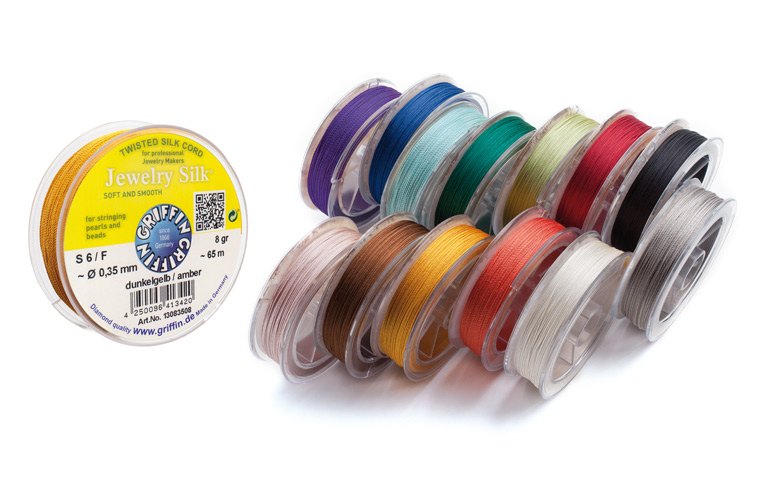
I found filament silk best suited for tassels. The weight and flexibility of the silk makes gorgeous tassels. Kanagawa 100 Denier Silk and Fujix Tire Silk come in an amazing array of colors. Kanagawa 1000 Denier Silk comes in 162 colors; Fujix Tire Silk in 121 colors; Griffin Jewelry Silk in 11 colors. The following tassel was made with Kanagawa color #5. The two Japanese brands, Kanagawa and Fujix Tire, are comparable and they are as far as I know the best filament silk available. Griffin Silk, a beading silk is also a very high quality silk suitable for tassels.

1. Cut a folded piece of cardboard a bit longer than the desired length of the tassel.

2. Insert the thread in the cardboard fold and wind the thread around.
This one was wound about 45 times around the card.
The more you wind the thread around the cardboard, the fuller the tassel will be.

3. With separate thread, bind all the tassel thread on one of the end.
I go around the bundle twice, then tie the two ends into a flat knot.
4. Cut the thread along the other end of the cardboard while holding the bound end.
Continue holding the bound end for next step.

5. Run the thread under lukewarm water to remove the folds and to make it easier to cut the ends.
Blot the tassel with a towel to remove excess water.
This step can be skipped with Griffin Silk, and with silk coming off of spools, but cutting wet silk is easier than cutting dry silk. It is just like getting your hair cut wet rather than dry...

6. Continuing while the tassel is wet…
With a separate piece of silk, wrap the tassel neck.
Stitch the ends back toward the tassel ends.

7. To trim the tassel, wrap the tassel in a piece of plastic shed.
Use your sharpest scissors to trim the ends.

Here is the finished tassel.

The finished length of this tassel after trimming is 4.5 cm long.
The head is about 5 mm in diameter.
The bottom of the tassel skirt is about 18 mm wide.

Tassels made with Kanagawa 1000 Denier Silk and Fujix Tire Silk.
Some are longer, fatter… The fattest one on the right was made with the full card.

Tassels made with filament silk.
The two on the right are made with Griffin Jewelry Silk Size 6.
The Kangawa and Fujix Tire silk tassels have a bit more sheen than the Griffin ones. Griffin Jewelry Silk is another filament silk often used for stringing beads. It is less sheen and more grip, so a bit easier to handle than Kanagawa & Fujix Tire. It is available in 12 colors at this time. Griffin Jewelry Silk comes in spools. Size 6 has 65 meters per spool.

Tassel made with Madeira Silk
This tassel is soft and fluffy, but the floss does not have the weight of the filament silk, so it does not hang quite as nicely. It might make a good tassel, but it would not be my choice for jewelry. Madeira Silk Floss come in 108 colors. It is made in Germany with spun silk from Switzerland.

Tassel made with C-Lon Micro Cord.
This tassel skirt is bit stiff. I may attach this ones to my keys or a purse, but I would not attach it to a strand of beads, nor wear it as a jewelry charm…

I am now experimenting with tassels made with Chinese Knotting Cord, so far I really like the results with Micro Size E. > Read New Post on Tassels
See latest post on tassel HERE.
Silk - References

All these fine silks are available at Jewels in Fiber online store
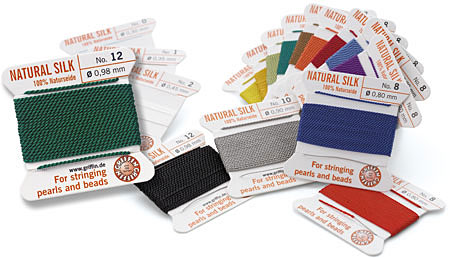
Here are the silks, I tested for tassels. I made the same types of tassels growing up in Geneva, Switzerland. I came up with a few improvements while making them this past week… Oh, I was told at the show I just attended that books are good to wind the thread around to make the tassels. I will try this next.
I have several books on tassels, but I have yet to make one of the fancy tassel featured in them. If you are interested in further research in the art of passementerie, that is the French word for fancy decorative trimming such as tassels, braid and fringing, check books on tassels and look for future posts on the subject!
I have several books on tassels, but I have yet to make one of the fancy tassel featured in them. If you are interested in further research in the art of passementerie, that is the French word for fancy decorative trimming such as tassels, braid and fringing, check books on tassels and look for future posts on the subject!